Home Office extended liability rules for illegal working: What UK businesses need to know
Home Office extended liability rules could expose UK businesses to civil penalties for illegal working. Here’s what the new rules mean for your business.
 Darren Faife ● Oct 12, 2026

Key facts:
- Effective from: 1 October 2026
- Who may be affected: Businesses beyond the worker’s direct employer
- Potential consequence: Civil penalties for illegal working
- Action: Review right to work compliance procedures
New Home Office guidance expands the circumstances in which businesses could face civil penalties for illegal working.
The extended liability provisions cover certain worker, subcontracting, managed service, online matching and substitution arrangements, meaning liability may extend beyond the worker’s direct employer.
Businesses involved in these arrangements need to look beyond their direct employees when reviewing right to work compliance. They could face civil penalties even where they did not directly employ the worker.
What are the Home Office extended liability rules for illegal working?
The Right to Work rules now go beyond traditional employees in certain circumstances.
Businesses may need to carry out right to work checks and put appropriate compliance controls in place where people are engaged as workers, individual subcontractors, through certain online matching services or under contracts that allow substitution.
Section 48 of the Border Security, Asylum and Immigration Act 2025, which came into force on 1 October 2026, introduced these changes to the Right to Work Scheme.
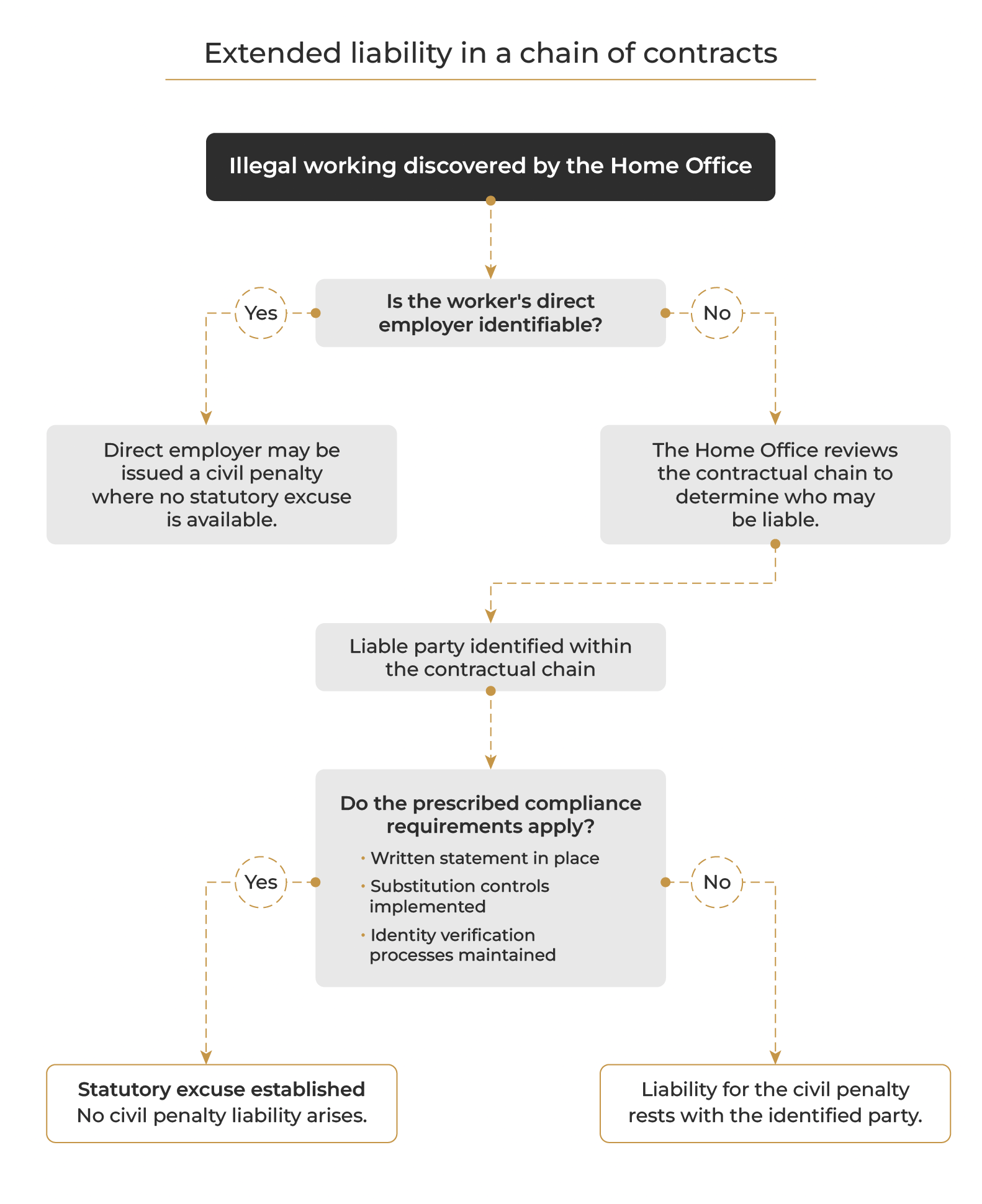
The direct employer remains responsible for carrying out right to work checks on the individuals it employs. However, another organisation further up a contractual chain may also face civil penalty exposure where the conditions for extended liability are met.
The potential liability chain can be illustrated as follows:
Which business arrangements fall within scope?
The Home Office identifies several types of arrangements where extended liability may apply.
Worker and subcontractor arrangements
The extended provisions can apply to certain individuals engaged under a worker's contract and to individual subcontractors. Businesses that sponsor workers should consider how these changes interact with their sponsor licence obligations
They can also apply where one organisation is contracted to provide work or services to a third party and then enters into a further contract with another employer to provide workers to fulfil that contract.
This means liability can potentially extend beyond the organisation that directly employs or engages the individual. In certain circumstances, a business can be treated as employing an individual further down a contractual chain, even where there is no direct contract with that person.
Regular immigration compliance audits can help businesses identify potential gaps in their right to work processes and contractual arrangements.
For example, the Home Office uses a construction company that engages other businesses through a chain of contracts to provide workers for a house-building project to illustrate how extended liability can apply.
Online matching services
Certain online matching services can also fall within scope where they provide details of an individual service provider to potential clients or customers, and the service provider then contracts with the client or customer.
An individual does not have to be directly employed by the online matching service for the arrangement to potentially fall within the provisions.
Substitution arrangements
Extended liability can apply where an individual is engaged under a contract containing a substitution provision.
Where substitution is permitted, businesses should consider how they establish the identity and right to work of the person who actually carries out the work. This may include verifying identity, carrying out relevant checks, recording substitutions and re-verifying identity where appropriate.
Managed services
Managed service arrangements can also fall within scope, depending on how the work and contractual relationships are structured.
Which arrangements are not covered?
Not every contractor, supplier or outsourced service arrangement falls within the extended liability provisions.
Examples of arrangements outside scope include:
- Agency worker arrangements
- The supply of goods, where the arrangement involves products rather than workers providing work or services.
- Certain food ordering platform arrangements, where the platform does not engage the workers providing the service.
These examples show why businesses need to assess their specific contractual and working arrangements rather than assume every outsourced or platform-based service is covered.
How can businesses establish a statutory excuse?
Home Office guidance sets out measures businesses can consider when seeking a statutory excuse from extended liability.
Review contractual terms
Businesses should assess whether their contracts include the prescribed provisions relating to right-to-work requirements.
A written statement containing the required contractual terms and conditions must be in place before work or services commence where the relevant extended liability arrangements apply.
Control substitution arrangements
Where substitution is permitted, businesses should establish how substitutes will be identified and how their right to work will be checked before they start work.
Appropriate substitution controls should also be in place to prevent an unauthorised person from carrying out the work.
Where substitution is not permitted but occurs anyway, businesses should consider what evidence they have regarding the individual who actually carried out the work.
Verify identity
Examples of identity verification measures include ID cards, facial recognition, biometric systems, training or professional licence checks and re-verification of identity.
What should businesses do now?
Businesses using subcontractors, managed services, online matching services or substitution arrangements should review how their contractual arrangements operate and whether extended liability could apply.
Consider:
- Contractual arrangements: Identify arrangements that could fall within scope.
- Substitution processes: Establish how substitutes will be identified and how their right to work will be established.
- Identity verification: Check that the person carrying out the work is the individual whose right to work has been checked.
- Evidence: Keep appropriate records of the checks and controls relied on when seeking to establish a statutory excuse.
Key compliance lessons for UK businesses
Extended liability does not mean another organisation automatically takes on the direct employer’s responsibility for right to work checks.
However, businesses involved in certain contractual arrangements could still face civil penalties for illegal working. Reviewing where the rules may apply, and putting the right contractual, substitution and identity checks in place, can help businesses understand and manage their potential exposure.
How Sable International can help
If your business uses subcontractors, managed services, online matching arrangements or contracts that allow worker substitution, Sable International's UK Business Immigration team can help you assess your arrangements, review right to work compliance procedures and identify potential compliance gaps.
Need expert guidance? Contact Sable International's UK Business Immigration team to review your workforce model, contractual arrangements and right to work compliance framework. Email us at [email protected] or call +44 20 7759 5316.



Cyber Essentials
Our Cyber Essentials certification reflects our ongoing commitment to cybersecurity best practices, ensuring that we safeguard sensitive data and operate with a high level of digital integrity.